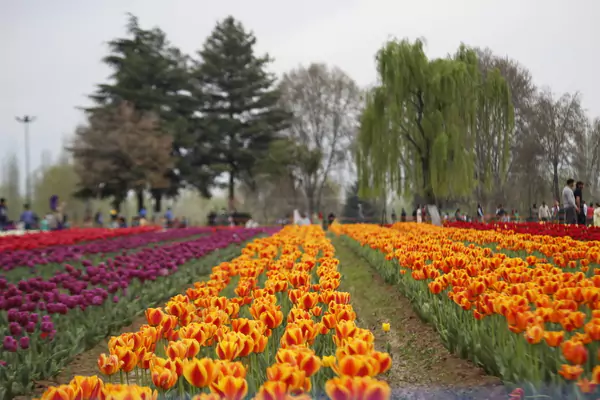
Every spring between late March and mid-April, the Kashmir Valley emerges from winter slumber in an explosion of color. The premier centerpiece of this seasonal awakening is the Indira Gandhi Memorial Tulip Garden (formerly known as Siraj Bagh), nestled gracefully on the gentle slopes of the Zabarwan mountain range overlooking Dal Lake.
Spanning over 30 hectares, it is recognized as the largest tulip garden in Asia, showcasing over 1.7 million tulip bulbs across 70+ varieties, alongside daffodils, hyacinths, and ranunculus.
Because the bloom lasts only 20 to 30 days, hundreds of thousands of travelers converge on Srinagar during this narrow window. Here is your essential guide to navigating tickets, dodging traffic jams, and capturing unforgettable spring photographs.
Quick Facts
| Parameter | Details |
|---|---|
| Typical Opening Window | Late March to mid-April (Exact dates announced annually by Floriculture Dept based on spring temps). |
| Location | Cheshmashahi Road, between Botanical Garden and Dal Lake, Srinagar. |
| Entry Tickets | Adults: approx. ₹75 – ₹100; Children: approx. ₹30. Tickets available at counter or online. |
| Best Time of Day | 8:30 AM to 10:30 AM (Soft morning light; lowest crowd density). |
| Associated Blooms | Badamwari (Almond blossoms in Old City) blooms roughly 10 days before the Tulip Garden. |
| Last Verified Date | October 2026 |
Understanding the Bloom Timing
Tulips are highly sensitive to soil and ambient temperatures. A warmer March causes the bulbs to flower early, while prolonged late-winter cold snaps can delay the opening until the first week of April:
[Mid-March] ────> Almond blossoms burst open at Badamwari (Old City)
[Late March] ───> Tulip Garden officially opens; early varieties bloom
[Early April] ──> Peak Bloom: All terraced beds saturated in rainbow stripes
[Mid-April] ────> Late varieties; petals begin to fall with warmer spring rains
The Garden Architecture
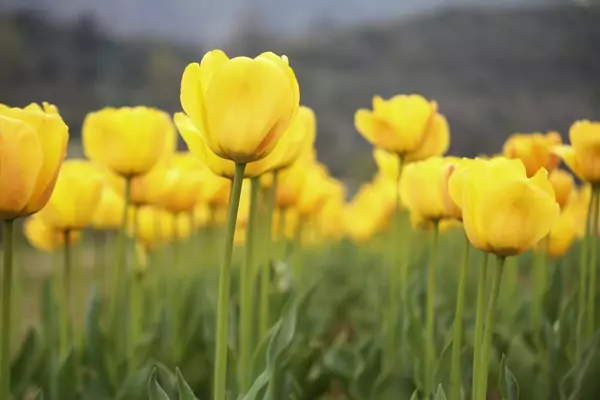
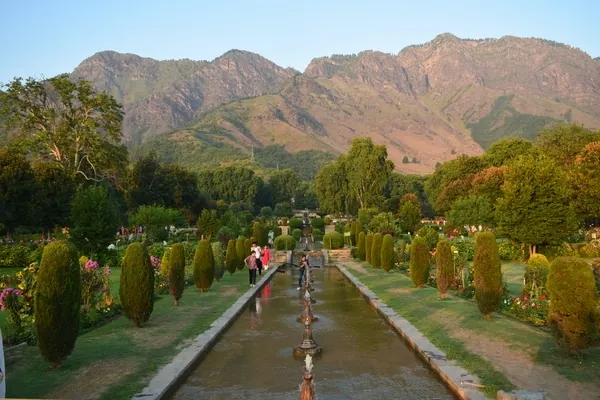
The garden is arranged on seven ascending terraces designed to mimic classic Mughal canal systems. Water flows down central cascades flanked by perfectly straight, symmetrical flower beds planted in solid bands of yellow (Strong Gold), dark purple (Queen of Night), fiery red, delicate pink, and bi-color ruffled varieties.
4 Rules to Beat the Crowds & Traffic Jams
During the Tulip Festival, Boulevard Road and Cheshmashahi Road frequently experience severe vehicular gridlock between 1:00 PM and 6:00 PM.
- Arrive at the Gates at 8:30 AM: The garden officially opens at 9:00 AM (gates sometimes open at 8:30 AM). Arriving early allows you to photograph pristine, dew-covered petals with empty pathways before busloads of tour groups arrive.
- Avoid Weekend Afternoons: Srinagar locals celebrate spring on Saturdays and Sundays. Weekdays (Tuesday through Thursday) offer a substantially calmer viewing experience.
- Use Two-Wheelers or Walk from Boulevard: If traffic on Boulevard Road comes to a halt, you can walk or hire a local electric scooter or auto-rickshaw to drop you near the Botanical Garden cut.
- Combine with Cheshma Shahi & Pari Mahal: After visiting the tulips, walk up the hill to the natural freshwater spring of Cheshma Shahi and the arched terraces of Pari Mahal.
Don’t Miss Badamwari: The Almond Blossom Prelude
While tourists focus solely on tulips, Srinagar locals cherish an older spring tradition: Badamwari.
- What It Is: A historic 300-year-old almond orchard situated at the foot of Koh-i-Maran (Hari Parbat fort) in downtown Srinagar.
- The Experience: In mid-to-late March, thousands of almond trees burst into a delicate sea of pale pink and white blossoms. Families gather on picnic rugs with brass samovars to sip hot kehwa and listen to traditional Kashmiri folk musicians playing the santoor.
- Entry: Modest entry fee (₹24); minimal commercial touts.
Photography Tips for Spring in Srinagar
- Low-Angle Perspective: Crouch low to the ground and point your camera upward through the tulip rows toward the towering, snow-capped Zabarwan peaks in the background.
- Depth of Field: Use a wide aperture ($f/1.8$ to $f/2.8$) to isolate a single vibrant tulip in sharp focus while blurring the surrounding sea of colors into a soft, creamy background.
- Attire Choice: Bright white, pastel yellow, or sky-blue clothing contrasts beautifully against the intense reds and purples of the flower beds.
Photo gallery