Note
✅ Status update (5 November 2026): The Kashmir Great Lakes trek is open. This was verified by the Travelihood team on the ground. Conditions in Kashmir can change at short notice, so check with your hotel, driver or operator before you set out. Trek season normally runs from late June to mid-September. Book treks only with a registered operator.
Widely acclaimed as the most spectacular alpine wilderness trek in India, the Kashmir Great Lakes (KGL) Trek traverses seven remote, high-altitude glacial lakes, three demanding mountain passes over 13,000 feet, and vast wildflower meadows rolling beneath the hanging ice walls of Mount Harmukh (16,870 ft).
Spanning approximately 72 kilometers from Sonamarg to Naranag, KGL is not a casual walk. It is a rigorous, high-endurance Himalayan expedition that requires acclimatization, cardiovascular fitness, and strict adherence to military security protocols along the northern ranges.
Here is the authoritative, boots-on-the-ground route guide and preparation manual for KGL.
Quick Facts
| Parameter | Details | |
|---|---|---|
| Trek Distance & Duration | 72 km \ | 7 Days (including 1 buffer day). |
| Trek Season | July to early September (Passes are snow-blocked prior; meadows turn brown by late Sept). | |
| Max Elevation | Gadsar Pass (13,750 ft / 4,191 m). | |
| Difficulty Rating | Moderate to Difficult. Daily walks of 5 to 7 hours with steep pass ascents and boulder crossings. | |
| Starting & Ending Points | Starts at Shitkadi (Sonamarg) ──> Concludes at Naranag Temple Ruins (Wangath). | |
| Permits & IDs | Indian Army clearances mandatory at military checkposts along route; original Aadhaar Card required. | |
| Last Verified Date | October 2026 |
Day-by-Day Expedition Trail Map
Day 1: Sonamarg (Shitkadi Base: 7,800 ft) ──> Nichnai (11,500 ft)
Day 2: Nichnai ──(cross Nichnai Pass: 13,100 ft)──> Vishansar Lake (12,000 ft)
Day 3: Acclimatization & Kishansar Lake Exploration (12,500 ft)
Day 4: Vishansar ──(cross Gadsar Pass: 13,750 ft)──> Gadsar Lake (12,000 ft)
Day 5: Gadsar ──(Military Checkpoint)──> Satsar Lakes (12,000 ft)
Day 6: Satsar ──(cross Zaj Pass: 13,400 ft)──> Gangabal & Nundkol Lakes (11,500 ft)
Day 7: Gangabal ──(steep 4,000 ft knee-jarring descent)──> Naranag Roadhead
The Lakes & The High Passes
1. Vishansar & Kishansar Lakes
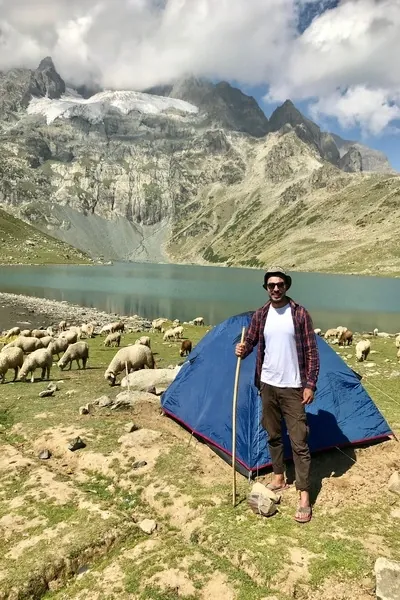
- Vishansar (“Lake of Vishnu”): A cobalt-blue glacial tarn fed by hanging snowfields, nearly 1 km in length. In early morning, the lake surface is mirror-still, reflecting the twin peaks behind it.
- Kishansar Lake: Sitting 500 feet higher, Kishansar lies just above Vishansar, framed by a steep ridge of scree and alpine grass. Both lakes are famous for brown and rainbow trout (fishing permitted only with authorized government license).
2. Gadsar Pass (13,750 ft) & Gadsar Lake
- The Climb: Ascending from Kishansar to Gadsar Pass is the steepest climb of the trek. As you cross the narrow rocky col, you can look backward and witness both Vishansar and Kishansar lakes simultaneously in a single jaw-dropping frame.
- Gadsar Lake (“Lake of Flowers”): Descending from the pass leads into an untouched paradise of floating ice chunks and alpine meadows bursting with blue poppies, irises, and potentillas.
3. Satsar: The Seven Interconnected Tarns
A collection of seven small alpine lakes nestled in a high granite basin. Reaching Satsar requires hopping across massive granite boulder fields.
4. Gangabal & Nundkol (Under Mount Harmukh)
- Nundkol Lake: Perched directly at the foot of the jagged, glacier-sheathed north face of Mount Harmukh.
- Gangabal Lake: The largest of all the lakes, revered in Kashmiri Hindu mythology as the “Ganges of Kashmir.” Spending your final camp night beneath Harmukh is an unforgettable wilderness experience.
Mandatory Physical Training & Fitness Benchmarks
Do not attempt KGL without at least 6 to 8 weeks of dedicated aerobic preparation:
- Cardiovascular Benchmark: You should be able to run 5 kilometers in under 32 minutes comfortably before embarking on the trek.
- Stair Climbing: Practice climbing 30 to 40 flights of stairs carrying a 5 to 7 kg backpack to strengthen your quadriceps and calves for the relentless downhill descent into Naranag on Day 7.
- Trekking Shoes: Invest in sturdy, waterproof, high-ankle trekking boots (e.g., Quechua Forclaz, Salomon, or Columbia). Break them in thoroughly on trail walks before arriving in Kashmir to prevent debilitating blisters.
Permits & Checkpoint Protocols
Because KGL operates in proximity to the Line of Control, travelers pass multiple Indian Army checkposts (specifically near Satsar and Gadsar).
- Physical ID Inspection: Every trekker must produce their physical original Government ID (Aadhaar Card) and permit slips issued by the J&K Tourism & Wildlife Department.
- Foreign Trekkers: Must ensure their agency has secured prior security clearances from the Home Department; foreign passport logging is exhaustive.
Photo gallery